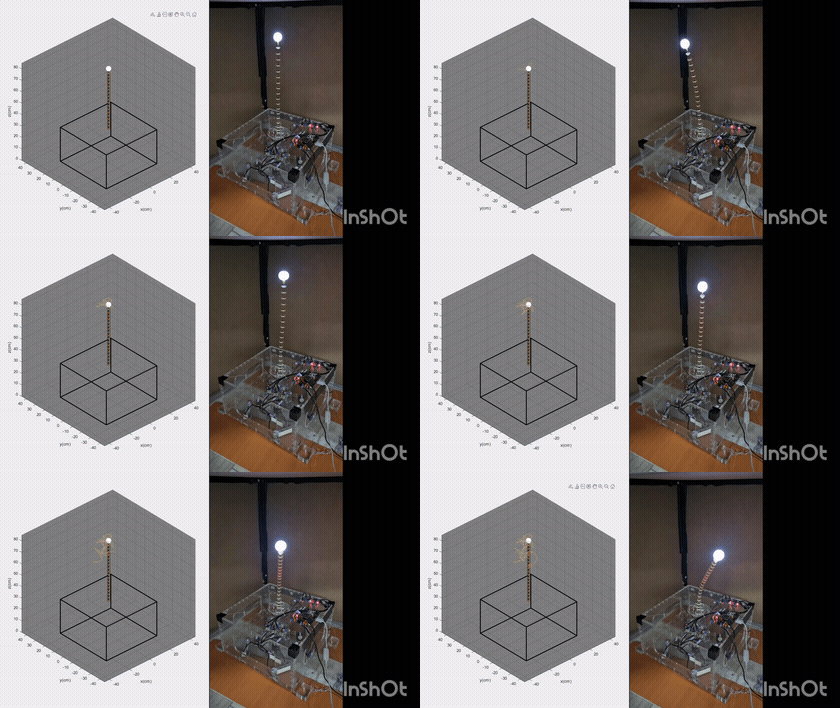
Project · Jun 2024
Continuum RoboArm
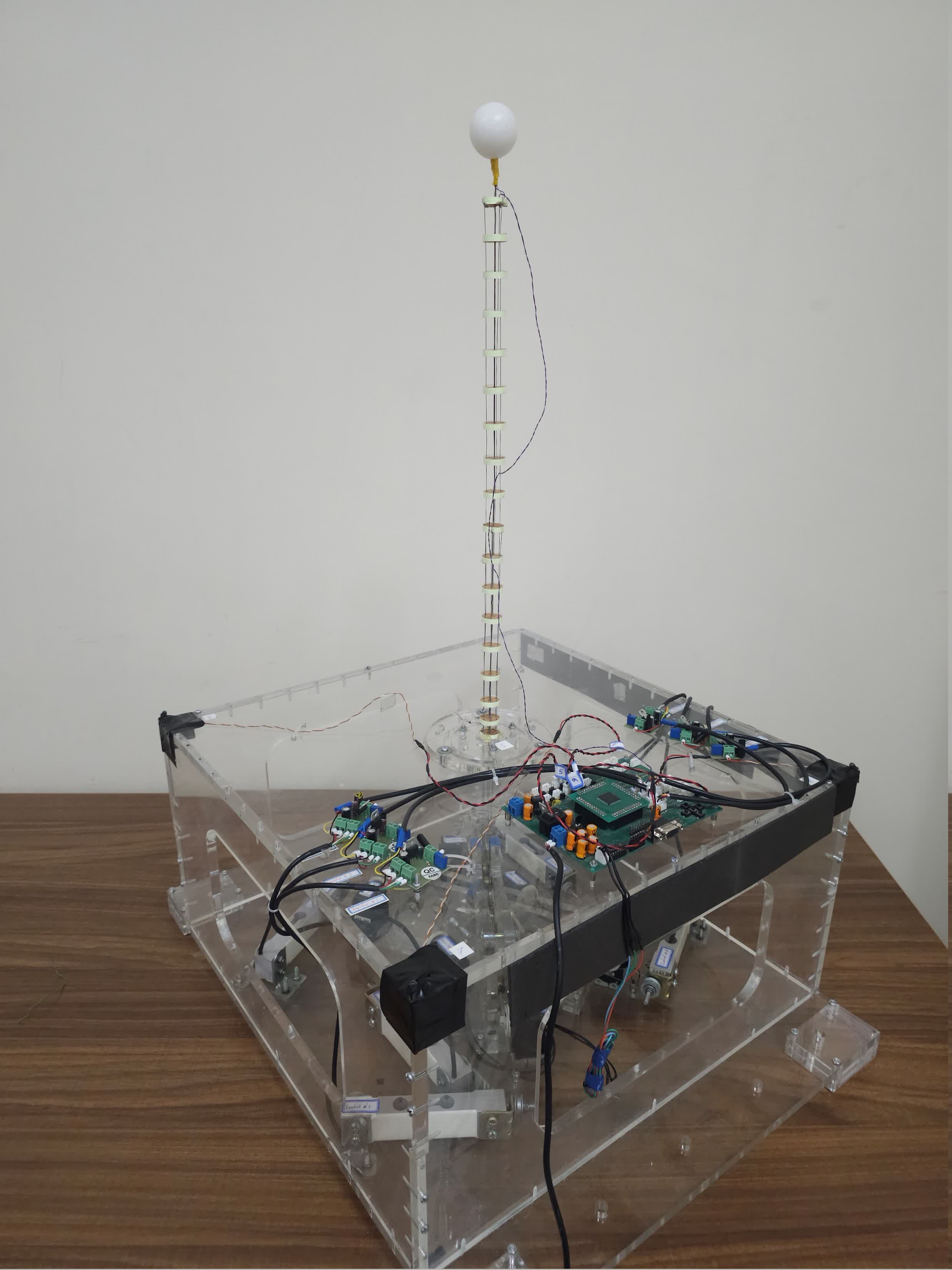
Continuum robots — arms with no rigid joints, capable of bending continuously along their length — are attractive for minimally invasive surgery and confined-space work, but their (theoretically infinite) degrees of freedom make first-principles dynamic modeling either too slow for real-time control or too inaccurate to be useful.
This project, my B.Sc. thesis at K. N. Toosi University of Technology, takes a data-driven system identification approach instead. I built and instrumented a two-segment, tendon-driven continuum arm (“RoboArm”) — 6 Dynamixel motors, 6 load cells for tendon force, dual-camera end-effector tracking — then:
- Calibrated the force-sensing load cells and closed a discrete PID force-feedback loop around each tendon.
- Designed a safe, information-rich excitation signal (equilibrium force grid + band-limited noise, saturation-limited) to sweep the full workspace.
- Collected input/output data and split it sequentially into train/validation/test sets.
- Identified and compared linear (ARX/ARMAX), quadratic-in-parameters (GA-selected regressors), and NARX neural network models — both as open-loop simulators and one-step-ahead predictors.
Outcome: the NARX neural network gave the best simulation accuracy (up to 81% fit), while ARMAX matched it almost exactly for one-step-ahead prediction (up to 91% fit) at a fraction of the computational cost — making it a strong candidate for real-time model-predictive control of the arm.